
The next battleground in embedding financial services: competing for discoverability in the age of agentic AI

Daniel Szmukler
Executive Director Euro Banking Association (EBA)
In his current role, Daniel is in charge of innovation, membership relations, strategic engagements and educational activities. He runs the association’s thought leadership working groups, the EBAday conference and the EBA’s professional training seminars and schools (EBA Academy). Daniel completed a first term of office as Head of Communications and Corporate Governance at EBA CLEARING from 2002 to 2012. From 2001 to 2002, Daniel was a Payment Systems Advisor to the European Banking Federation (EBF) in Brussels. He began his professional career in 1994 with SWIFT in La Hulpe. Daniel holds graduate degrees in business administration and management from Boston University, Mass. and from the Free University of Brussels. He also completed a Strategy and Leadership course at University of Oxford.

Mounaim Cortet
Mounaim Cortet is Vice President at INNOPAY, an Oliver Wyman business, leading its German team. With 15+ years of experience, he brings deep expertise in business strategy, digital transformation, and innovation in financial services. He advises organizations on (re-) defining their business models and operating strategies to thrive in emerging digital ecosystems, with a focus on Open Finance, payments, and digital identity.

Patrick de Haan
Patrick de Haan is Manager at INNOPAY, an Oliver Wyman business. Drawing on nearly a decade of experience, he works at the intersection of technology, regulation, and financial services innovation. He supports clients in turning industry developments into actionable strategies, new digital propositions, and growth opportunities, particularly in payments, Open Finance, and digital banking.
Over the past decade, financial services have undergone fundamental shifts in how data and products are accessed, distributed and consumed.
Initially, Open Banking unlocked regulated and standardised access to payment services and financial data for third-party providers, enabling new data-driven financial offerings for consumers and businesses, while laying the foundation for a more connected financial ecosystem.
Then, Embedded Finance moved financial products out of traditional banking channels and integrated them directly into software platforms, marketplaces and digital workflows where customers already conduct their business and financial activities.
Financial services have already become increasingly smart as institutions have deployed machine learning models for fraud detection, underwriting and customer segmentation, while more recently generative AI has enhanced customer service, advisory and employee productivity. Yet despite these advances, most AI systems remained largely advisory in nature: they informed decisions but rarely executed them.
Agentic AI represents the next step in this evolution, enabling autonomous execution as a new capability layer that not only informs decisions but can increasingly take context into account, orchestrate actions and execute financial tasks across institutions, platforms, and customer journeys. Individually, each of these developments has significant impact on the financial ecosystem. Together, they have the potential to fundamentally reshape how financial services are accessed, delivered, used, and managed – and, thereby, to redefine the role of financial institutions within the broader ecosystem.
From embedded products to embedded workflows
Embedded Finance is commonly defined as the integration of financial services into non-financial platforms and customer journeys. Over the past few years, this model has enabled businesses to access payments, lending, accounts, insurance and other financial products directly within their preferred software platform.
Agentic AI represents a different type of innovation. Unlike traditional AI systems, which primarily generate insights or respond to prompts, agentic AI systems can pursue objectives, plan actions, coordinate across systems and execute multi-step tasks with limited human intervention. The convergence of these two developments is particularly powerful.
While Embedded Finance determines where financial services are delivered, agentic AI increasingly influences how financial decisions are made and executed. Until now, humans remained at the centre of most financial decision-making processes. They searched for products, compared providers, reviewed offers, submitted applications and managed their financial relationships, often supported by increasingly sophisticated analytics, machine learning models and AI-powered assistants. Yet, the responsibility for connecting information, making decisions and executing actions largely remained with the customer or employee.
Agentic AI has the potential to change this dynamic. As AI systems become capable of researching options, comparing providers, recommending products and initiating actions on behalf of users, control over product discovery, selection and execution may increasingly shift towards the entities operating those agentic experiences.
For regulated financial service providers, the question is no longer whether agentic AI will shape Embedded Finance but what role their institution chooses to play in this rapidly evolving digital ecosystem.
The Agentic Embedded Finance Battleground
The answer may lie in understanding how (agentic) intelligence is likely to be distributed across future Embedded Finance ecosystems.
Three distinct but complementary agentic roles are beginning to emerge.
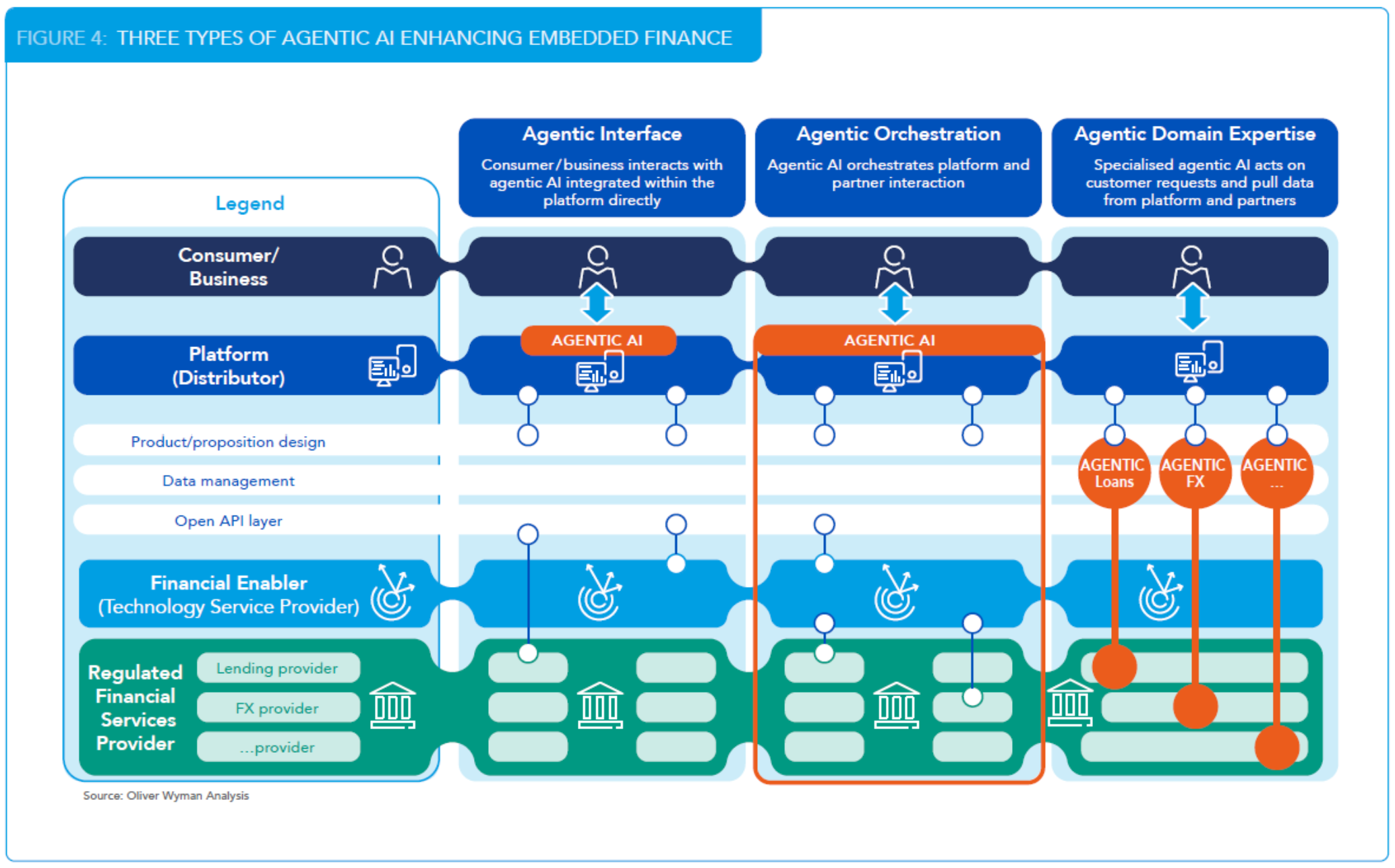
- Agentic Interface: customer-facing agents embedded into software platforms, marketplaces, ERP systems, accounting solutions and other digital ecosystems. These interfaces interact with users directly and support identifying needs (such as funding gaps, cash flow requirements or other operational tools by analysing the user’s real-time data and software context), comparing different financial offers and initiating financial actions within set guardrails.
- Agentic Orchestration: the intelligence layer that coordinates workflows across multiple participants, providers and services. These agents determine which providers to engage, how processes should be sequenced and how outcomes should be delivered to the customer.
- Agentic Domain Expertise: specialised financial intelligence embedded within regulated financial institutions. These capabilities include product logic, risk management, compliance requirements, pricing models and financial decision-making expertise.
While non-bank platforms and financial enablers are likely to focus on interfaces and orchestration layers, as they own the customer journey and connect to multiple providers, regulated financial institutions retain a unique opportunity to own the domain expertise layer.
Historically, regulated financial institutions have focused on building and maintaining direct customer relationships. More recently, many have expanded their reach through selected embedded finance partnerships (e.g. Revolut Business & Xero[1], Deutsche Bank & Check24[2], UniCredit & Amazon[3]) to make their services available in a broader range of customer journeys. In the emerging era of agentic finance, differentiation may increasingly focus on ensuring that their expertise, products and services can be accessed and acted upon effectively through AI-driven platforms.
Why discoverability may matter more than visibility
For many years, regulated financial institutions have sought to maintain visibility and engagement across the customer journey, serving as a familiar, direct and trusted point of access to financial products and services.
AI agents may challenge that logic. If customers increasingly use AI tools to search for, compare and access financial products, financial institutions will not only need to be visible to customers. They will also need to be visible and selectable by the systems acting on the customer’s behalf.
That requires more than a digital front end. Product information must be structured and machine-readable. Eligibility rules, pricing and service conditions must be clear enough to compare. APIs must support reliable access and execution. Consent, authentication and liability need to be designed into the journey from the start.
In this environment, the focus may shift from direct customer engagement to ensuring that products and services can be effectively discovered, assessed and acted upon by AI agents operating on behalf of customers. This is not solely a question of technology. It has implications for product design, distribution models, partnerships, risk management and the role regulated financial services providers choose to play within the embedded finance value chain.
Preparing for Agentic Embedded Finance
The convergence of Embedded Finance and agentic AI is still at an early stage. Many issues remain unresolved, including governance, accountability, digital identity, interoperability and regulation.
But the direction is becoming clearer. Success may depend less on whether a regulated financial services provider offers the most visible AI assistant and more on how easily its products and capabilities can be discovered, assessed and integrated within third-party journeys, while continuing to deliver distinctive value in a trusted and reliable manner.
For leadership teams, this raises five practical questions:
- Are our products easy for external systems to identify and assess?
- Are our APIs reliable enough to support real-time selection and execution?
- Do we know where we want to sit in the future Embedded Finance value chain?
- Where must human approval remain mandatory?
- What capabilities do we need now to stay relevant as customer journeys become more agent-mediated?
These questions go beyond innovation teams. They belong to the strategic agenda because they affect distribution, operating models, partnership choices and risk accountability.
The next phase
Open Banking made financial data accessible. Embedded Finance moved financial products into third-party journeys. Agentic AI could add a new layer: AI-supported selection and execution.
This does not mean regulated financial services providers become entirely automated or independent of human guardrails. Nor does it mean they should rush to build AI agents for every use case. The more immediate challenge is more practical: making products, data, and services ready for a world in which customers may increasingly rely on AI tools to navigate financial decisions.
For regulated financial services providers, the question is therefore not only whether agentic finance will emerge. It is whether they are prepared to be selected, trusted and safely executed within it.
The EBA Open Finance Working Group report titled “Supercharging Embedded Finance with Agentic AI” explores this topic in greater depth, including emerging ecosystem models, high-potential use cases, strategic considerations, implementation approaches and the collaborative foundations required to enable agentic finance at scale.
Reference: The findings will be discussed during the EBA’s two upcoming webcasts on 16 and 20 November 2026.
Click here to register and download the report (EBA Members only) or the fact sheet.
[1] https://www.revolut.com/business/integrations/xero-integration/
[2] https://www.deutsche-bank.de/pk/lp/db-api/embeddedfinance.html#use-cases
[3] https://www.embeddedfinancereview.com/amazon-germany-partners-with-hypovereinsbank-and-banxware-for-embedded-lending-with-credit-lines-up-to-eu5-million/
If you would like to comment on a blog post, please identify yourself with your first and last name. Your name will appear next to your comment. Email addresses will not be published. Please note that by accessing or contributing to the discussion board you agree to abide by the terms of the EBA blogging terms of use, so please read them carefully.